Showing posts with label STEM books. Show all posts

Thursday, June 30, 2022

7 Days of Books for Children, Day 5 STEM and Historical NF


Here we are on Day 5 of #7DaysOfBooks with STEM/STEAM-related topics and historical nonfiction. 

I grouped these two categories together because they often are inter-related. Discoveries in science happen over time and our knowledge builds on all that has come before. Plus, if we want to know where we are heading in the future with scientific discoveries and where our values and priorities might lie with new technologies, then we need to have a clear understanding of where we've come from. 

Interest in the sciences, math and technology runs deep through my family roots--at least as far as I can tell. My great-grandfather ran a train-engine repair shop as a superintendent on one of the railroad lines in Pennsylvania. My father is an electrical engineer whose early career involved getting photographic transmissions from space. 

The arts are often linked with science as well. Not only was STEM was broadened to STEAM, many early naturalists were creatives and made detailed illustrations of the plant and animal specimens that they studied and collected in the field. On that end my mother has been a creative for as long as I've known her. I grew up in a house where the walls were decorated in painted designs rather than wall paper, and pottery pieces were part of every room's decor since she was and still is a potter. She also gardens, and holds a keen understanding of how things grow--which is its own kind of science--and then brings the harvest in to make the most savory of dishes.

Roots. Our History. Our understanding of the world and how things are connected. It's all intertwined. Or, at the very least, they're connected for today's post.


A Penny's Worth
, written by Kimberly Wilson, illustrated by Mark Hoffman (Page Street Kids 2022)

This story is worth every cent and more. Packed with fun puns and word play, Penny's journey to find her self-worth in a world of other more valuable currencies comes to life with the energetic illustrations. The cast of charismatic characters, along with sprinklings of money math, educational back matter, and layers of social-emotional learning make this a perfect book for every family and classroom. I imagine this one will see many repeated readings.


A Dinosaur Named Ruth 
written by Julia Lyons, illustrated by Alexandra Bye (Simon & Schuster 2021).

When a young girl finds dinosaur bones and fossils on her ranch in South Dakota, her curiosity is sparked about where they came from. Determined to one day discover what kinds of animals the fossils belong to, Ruth doesn't give up on trying to get experts to look at her findings. Students will be inspired to make observations about nature and learn about interactions between organisms and their environment in their own backyard. The lyrical and engaging text, vibrant illustrations, and interesting story line make this book a perfect introduction to changes in habitats over time, conducting research, and following one's dream.


The Three Little Pigs and the Rocket Project written by Lynne Marie, illustrated by Wendy Fedan (Mac and Cheese Press 2022).

When the class at Fairy Tale Elementary are given an assignment to build toss rockets in order to see which rocket will fly the furthest, everyone is excited except Bibi Wolf. Despite trying to hold back her competitors, Bibi's big bad breath actually helps the rocket of one pig fly the furthest. This story is a fun introduction for any STEM building project in the classroom. The back matter even includes instructions for making toss rockets. 


Jack Horner, Dinosaur Hunter, written by Sophia Gholz, illustrated by Dave Shephard (Sleeping Bear Press 2021).

The study of scientific topics and the nature of discovery come alive in this comic-style picture book about the world-renowned paleontologist, Jack Horner, who discovered the first dinosaur egg fossils and consulted on the Jurassic Park dinosaur movies (among many other things). Although he had severe dyslexia, Jack Horner didn't let trouble with reading stop him from pursuing what he wanted to do. Plus, he loved hands-on science, and the illustrations in this book do a superb job of bringing the scientific experiments that interested Jack to life. I highly recommend this book for its engaging and interesting text and fast-paced story-telling.


Kid Scientist. Marine Biologists on a Dive
written by Sue Fliess, illustrated by Mia Powell (Albert Whitman 2022). 

Because this book shows how large marine organisms are studied, it pairs wonderfully with CRAB BALLET (shared on Nature and Animals Day 2 post), which focuses on inter-tidal ocean life, and THE BRILLIANT DEEP, which focuses on restoring ocean reef habitats. The straight-forward text shows science-in-action as five friends take to the ocean with different tasks. Incorporating many parts of the scientific method, the illustrations and text are engaging enough to plant the seeds for developing an appreciation for life found in our underwater ocean world. I predict much curiosity will be sparked among young readers.


Birds of Prey. Terrifying Talons
written and illustrated by Joe Flood (First Second 2022).

Raptors. 

Need I say more? This book is part of a nonfiction comic series that includes other titles like CROWS, CATS, and ROCKS & MINERALS. Packed full of information that might be found on the internet or in an encyclopedia, the graphic novel-style and story line will hook kids from page one in a presentation that is so much more interesting and meaningful than an internet search. Readers will learn about eating habits, evolution, and interdependences of raptors to other animals. I highly recommend this book because it's kid-friendly, fun, and educational. 


A True Wonder. The Comic Book Hero Who Changed Everything
, written by Kirsten W. Larson, illustrated by Katy Wu (Clarion Books, 2021). 

This story about the origins of the superhero Wonder Woman shows how she got her place in the comic book industry after the same man who had picked Super Man--an idea that had been rejected by every other syndicate in the business--decided to give a female superhero a chance. As time went on, the business of maintaining the Wonder Woman comic led to employing many other real-life woman wonders. Women like Alice Marble, a former top tennis pro; Joyce Hummel, a co-writer under the name Charles Moulton; and movie director Patty Jenkins. Young readers will see how Wonder Woman isn't only a superhero, she serves as a wonderful role model for equality, justice, peace, and following your dreams.


Listen. How Evelyn Glennie, a Deaf Girl, Changed Percussion, written by Shannon Stocker, illustrated by Devon Holzwarth (Dial Books for Young Readers 2022).

Sometimes, it's the things we're told that we can't do which inspire us the most. Such is the inspiring message of this book, where a young girl going through the heart-breaking and tremendously stressful experience of losing her hearing is determined not to lose the one thing she loves--creating music. This book will not only inspire students to go after their dreams, but also open their eyes (and ears) to the physics of sound. As a science teacher, I love this book not only for its story and beautiful text, but also for the subject. In our state our students begin learning about sound and sound waves in elementary school, which lands LISTEN with an A++++


Unspeakable. The Tulsa Race Massacre
, written by Carole Boston Weatherford, illustrated by Floyd Cooper (Carolrhoda Books 2021). 

An important book that delicately and deliberately handles a troubling and until recently a largely unknown part of American history. While reading I wondered what one event, which was based on decimating a thriving Black community, would look like. The end paper photo on the back cover reveals this, which made what I was feeling all the more raw and real. The final words of the story, which point toward rejecting hatred and violence and instead choosing hope, land the story in a place of longing for peace, equality, and love.


She Caught the Light. Williamina Stevens Fleming: Astronomer
, written by Kathryn Lasky, illustrated by Julianna Swaney (HarperCollins Children's Books 2021). 

This story shows how a bright and curious girl, whose experiences began with her father's photography business, got on track to becoming an accomplished astronomer due to the gentle nudge and suggestion from the wife of Professor Edward Pickering, for whom she worked as a housekeeper. This story shows how far one can go with a little help from others, and especially since Williamina's journey of classifying stars put her on a path toward connecting with other accomplished female scientists making discoveries in the field of astronomy.
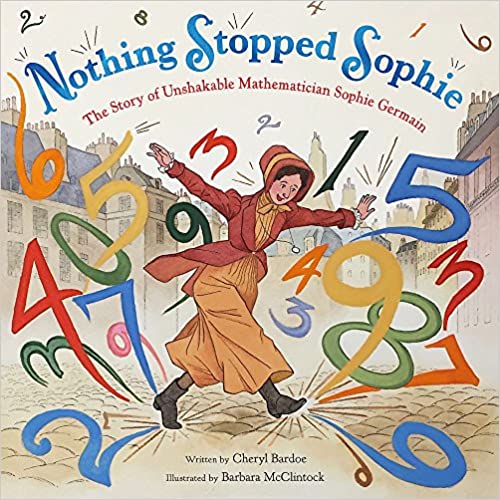


Nothing Stopped Sophie, written by Cheryl Burdoe, illustrated by Barbara McClintock (Little, Brown Books for Young Readers 2018).

Even though Sophie Germain grew up during a time of social inequality--when women were not allowed to practice mathematics or sciences, she persevered and kept doing what she loved to do. She focused on becoming self-taught in math, because she loved how it helped find order and balance in the world. In doing so, she was able to solve what had been deemed an unsolvable problem, which was to come up with a mathematical equation for describing/predicting waves for the way sand grains created patterns on a glass plate when exposed to vibrations. However, solving it didn't come easily. She failed two times before finding success, and she was the only person - a woman, no less - to do so. 


There are 3 amazing giveaways for today, so be sure to enter! Follow the guidelines in the Rafflecopter below.

1) A 30-minute zoom Q&A with author Lynne Marie

2) A signed copy of A PENNY'S WORTH from author Kimberly Wilson

3) A PB-manuscript critique or copy of A DINOSAUR NAMED RUTH from author Julia Lyon


a Rafflecopter giveaway

Friday, July 2, 2021

7 Days, 7 Books, Day 5. How to Catch a Clover Thief by Elise Parsley

 Today's books are those that pack a surprise in story or structure, which as a reader and writer I find absolutely delightful. These are books that show children how to think outside the box and enjoy the unexpected and then reflect on the path that brought them there.

How to Catch a Clover Thief is written and illustrated by Elise Parsley, and the first lines of this story show it isn't going to follow the typical "How to" structure.  Instead, readers are presented with a scene, a character, and what he wants, while the antagonist watches from the background with a book in hand.

The stems were tall. The leaves were large. Roy couldn't believe his luck--all this clover patch needed were those sweet white blossoms and then he could gobble up his favorite snack. They were nearly ready. He just needed to be patient. 

But as it turns out, being patient is not all Roy needs to do. Roy needs to find a way to outwit the clever rodent named Jarvis. This science teacher's heart soared with the final illustrations and path the story took, because it landed ingeniously and humorously in the lap of STEAM. And interestingly, young readers might go back and see where application of the scientific method lurked in the details all along. This book definitely ought to find its way into every child's hands. 


Turtle in a Tree written and illustrated by Neesha Hudson offers a fun read aloud with two characters who each see something different in a tree and each insist that they are right and the other is wrong. Of course, the twist at the end is clever, satisfying, and funny. Although this story doesn't wave the STEM flag from its cover, it can provide an interesting and unique tool for discussing the process of scientific inquiry and debate in the classroom. But aside from my own educational interests as an educator, Turtle in a Tree is simply plain fun and won't disappoint.


The Safe Return, written by Ashley Wheelock and Arwen Evans and illustrated by Abigail Gray Swartz, offers a surprise in the structure of the book, which in and of itself is STEAM-based in that it offers children an alternative way that a book can be created and enjoyed. The Safe Return offers the same story but illustrated from two different perspectives. Each story is read separately, with the first being read from the front cover and moving toward the middle of the book, and the second being read by flipping the book over and reading forward from the back cover. 


I imagine children will compare each story version and pick out the differences and the reason for the change. I also believe this book is a timely celebration of our world experience. It offers comfort and hope as we begin to shift back to a new normal after going through a pandemic.


With the U.S. holiday weekend of July 4th upon us, I'll pick up with the final two days of book recommendations on July 6th. 

Enjoy!


Tuesday, June 29, 2021

7 Days, 7 Books, Day 3. SOAKED by Abi Cushman

The books on yesterday's blog post allowed for deductive reasoning in young readers. Today's books provide a chance for higher order thinking skills. 

Wait! Don't let these nerdy teacher phrases make you nervous. Bear with me, PUN intended! 

Because look at this cover!


Aren't these animals adorable! And that umbrella! I must get myself that bee-utiful umbrella!

But don't worry, the books I'm sharing don't need to make you smart or anything. 

They are wonderful enough to enjoy for the pure pleasure of reading.

What I love about SOAKED is that at first glance, it doesn't seem to be about a science topic in any way. (No need to scare off the children). In fact, it seems to be more hinged on emotion given that its main character is a glum bear who reminds me of Eyeore from Winnie the Pooh who is trying to pass the time with friends on a rainy day. 


Yet, science teachers like me will quickly recognize that all of the elements of the water cycle shine through in the illustrations, which can instantly turn this book into a fun treasure hunt for evidence of processes like evaporation, precipitation, infiltration, interception, condensation, saturation, adhesion, and cohesion, as well as properties of water like universal solvency and dissolution, etc. 


Another wonderful book to pair with SOAKED is WATER IS WATER, A Book About the Water Cycle written by Miranda Paul and illustrated by Jason Chin. I suggest following up reading and discussion of both of these books with sipping apple juice! Read these books to find out why! Enjoy!


Monday, June 28, 2021

Seven Days, Seven Books, Day 2. Invent a Pet by Vicky Fang and Tidawon Thaipinnarong

Hold on to your seats, we're moving into Day 2 with the picture book, INVENT-A-PET written by Vicky Fang and illustrated by Tidawon Thaipinnarong.

INVENT-A-PET touches the "nerd heart" of this science teacher for showing the scientific method in action in a fun and creative way.


This time, instead of documenting what is found and observed in nature as shown in The Collectors for Day 1's post, we are now moving into keeping track of data and analyzing Outputs that result from Inputs. In essence, today's book is all about finding patterns to crack a code.


In INVENT-A-PET, Katie wants a pet of her own, but the goldfish suggested by her mother seems too ordinary. So when her mother gives Katie a machine that will allow her to invent an extraordinary pet, Katie jumps at the chance. Of course, as with most scientific endeavors, the process is not as straightforward as Katie expects and the pets she creates are definitely packed with surprising traits. Eventually Katie figures out how the machine works by monitoring each output that is produced for every input that is changed -- one at a time.


I love this story because it combines the process of coding with scientific discovery and experimentation.

In the classroom I can envision numerous ways in which this story could be used to spark imagination and engage learning. Three books below offer different applications and pairing that a teacher could use depending on their goals.
However, each story involves the common thread of understanding the links between inputs and outputs, as well as overcoming odds in finding solutions to seemingly impossible and difficult questions.

Counting on Katherine, How Katherine Johnson Saved Apollo 13, written by Helaine Becker and illustrated by Dow Phumiruk. This book relays the importance of patterns in numerical relationships and being able to recognize patterns in understanding when answers make sense. In this case, the lives of three men depended on the getting the answer right!


Gregor Mendel, The Friar Who Grew Peas, written by Cheryl Bardoe and illustrated by Jos A. Smith. This book tells the story of Gregor Mendel who was determined to figure out how breeding and artificial selection worked in cracking the code toward the inheritance of traits. Mendel is considered to be the Father of Genetics based on his detailed accounting of offspring over generations that were created from cross-breeding particular selections of parent plants.


The Leaf Detective, How Margaret Lowman Uncovered the Secrets in the Rainforest by Heather Lang and illustrated by Jana Christy. Margaret Lowman follows her dream to study and understand trees of the rainforest, a biome never studied before in Australia, particularly by a woman.


Sunday, June 27, 2021

Seven Days, Seven Books. Day 1. The Collectors by Alice Feagan

Hooray! I have been wanting to get back into doing this blog series for a while, and at last, here we are!

I have so many wonderful books to share. This time I'll be focusing on books that can be enjoyed in both a home and school setting--no matter the level--they're THAT GOOD! I teach high school science, and I'm always thrilled when I can see ways to weave fiction or informational fiction into learning and the nonfiction side of it. And if I find a book that can make reading AND learning fun, then you know it has to be fantastic. In this series I'll also be recommending companion books that can be paired with the daily feature title for similar or cross-curricular themes.

Day One is kicked off with a new favorite book: The Collectors, written and illustrated by the immensely talented Alice Feagon. When I look back at all the new releases I've read in 2021 and reflect on a list top ten, I can guarantee that this book will be sitting among the titles. 

the collectors by Alice Feagan

From the engaging prose to the amazing artwork to the captivating story that inspires wonder and exploration of our natural world, this story speaks to my scientifically-educated heart. In addition, big, bold words like Too Heavy!Too High!, and Too Hidden! are excitingly kid-centric and will draw readers in to both text and illustration.

I imagine young readers will be eager to forge into amassing their own collections of things that interest them, or simply step outside to explore. After being limited in this kind of movement through the last year and a half, isn't outdoor exploration what we all are eager to return to doing? 


I especially appreciate Feagan's depiction of the scientific approach to cataloging items that are collected by Winslow and Rosie. This part of the story can provide a handy tool for teaching the process of discovery science in the classroom.

I highly recommend The Collectors by Alice Feagan. This book deserves an active spot in any book collection.

Companion books that I recommend focus on a starting or expanding a different type of collection--one that involves growing a collection of cultural experiences and friendships. 

The Star Festival, written by Moni Richie Hadley and illustrated by Mizuho Fujisawa


Festival of Colors, written by Kabir Sehgal and Surishtha Sehgal and illustrated by Vashti Harrison


Dia De Los Muertos, written by Roseanne Thong and illustrated by Carles Ballesteros


The Invisible Boy, written by Trudy Ludwig and illustrated by Patrice Barton


Be Kind, written by Pat Zietlow Miller and illustrated by Jen Hill


See you on Day 2 for my next book recommendations!